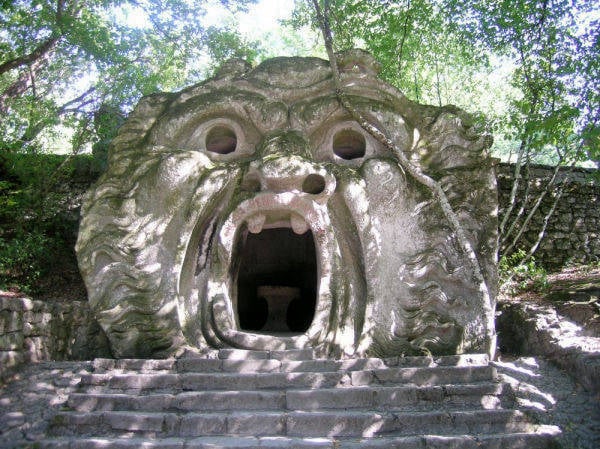
Sacro Bosco ("Sacred Grove"), colloquially called Park of the Monsters (Parco dei Monstri in Italian), also named Garden of Bomarzo, is a Manieristic monumental complex located in Bomarzo, in the province of Viterbo, in northern Lazio, Italy.
The garden was created during the 16th century. Situated in a wooded valley bottom beneath the castle of Orsini, it is populated by grotesque sculptures and small buildings located among the natural vegetation.
Opening hours:
The park is open every day of the year without a lunch break:
08.30 a.m.- 19.00 p.m. (from April to August)
08.30 a.m. - to sunset (from September to March)
Address:
Via Madonna della Valle 101
01020 Bomarzo (Viterbo)
(find directions and pictures below)
Link to the website
Nestled in the hills of northern Lazio—often mistakenly considered part of Umbria due to its cultural and geographic proximity—is the small Italian town of Bomarzo, famous for its surreal and enigmatic site known as the Parco dei Mostri or the Sacred Grove (Sacro Bosco). Created in the 16th century, this mysterious garden of giant stone sculptures, grotesque monsters, and mythological figures defies easy categorization. While not a typical historical monument like a cathedral or Roman ruin, Bomarzo’s Sacred Grove is a unique and deeply symbolic reflection of Renaissance thought, artistic experimentation, and human emotion.
A Renaissance Marvel with a Twist
The Sacred Grove was commissioned in the mid-16th century by Pier Francesco Orsini, known as Vicino Orsini, a nobleman, soldier, and poet. The Orsini family was one of the most powerful aristocratic families in Italy, with strong ties to the Papal States. After years of military service and personal tragedy, including the death of his beloved wife Giulia Farnese, Orsini withdrew from public life and turned his attention to his estate in Bomarzo.
Rather than create a traditional Renaissance garden—characterized by geometric symmetry, order, and classical beauty—Orsini sought to produce something radically different. The Parco dei Mostri became a landscape of grief, contemplation, irony, and philosophical reflection. Designed in collaboration with the architect Pirro Ligorio, who also worked on the Villa d’Este in Tivoli, the garden took shape as a “sacred wood” filled with monstrous sculptures carved from the local volcanic rock (peperino).
The Park of Monsters: A Landscape of Enigma
Walking through the Sacred Grove is unlike visiting any other Renaissance garden. The path winds through trees and uneven terrain, revealing one surreal sculpture after another. There is no clear axial alignment or narrative flow. Instead, visitors encounter fragmented mythological scenes, grotesque faces, tilted buildings, and cryptic inscriptions that challenge rational understanding.
Some of the most iconic features include:
The Leaning House (Casa Pendente): A small stone building intentionally constructed at an angle, disorienting visitors and defying the Renaissance ideals of balance and harmony.
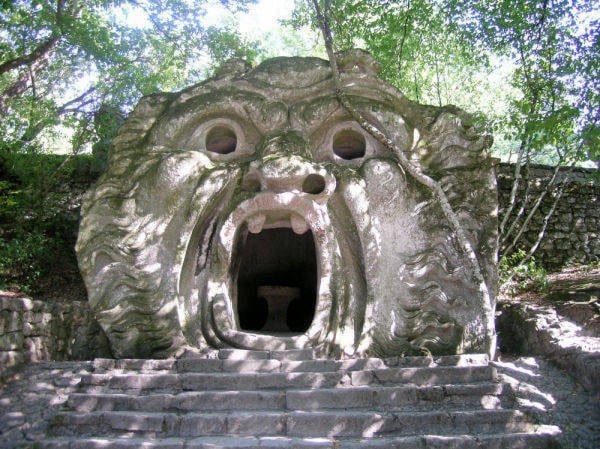
The Orc’s Mouth (Orco): A giant stone face with its mouth wide open, large enough for visitors to step inside. Above the entrance is the inscription “Ogni pensiero vola” (“All thoughts fly”), suggesting liberation from reason or perhaps the fleeting nature of thought.
The Dragon Battle: A dramatic scene where a dragon is attacked by lions and other creatures, possibly symbolizing chaos or inner struggle.
Hannibal’s Elephant: A sculpture of an elephant crushing a Roman soldier, perhaps a reference to the historical trauma of the Punic Wars or simply an homage to the exotic.
The Giant (Il Gigante): A massive figure tearing another in two, often interpreted as a metaphor for inner conflict or violent transformation.
Throughout the park, inscriptions in Italian and Latin pose philosophical questions or express existential sentiments. These are not merely decorative but act as invitations to reflect on mortality, love, illusion, and truth.
Interpreting the Enigma
For centuries, the Sacred Grove remained a mystery. Largely forgotten after Orsini’s death in 1585, the site fell into disrepair and was slowly reclaimed by nature. Unlike the formal gardens of Florence or Rome, Bomarzo’s surreal landscape was too strange, too emotionally raw, and too unclassical to fit into the dominant narratives of art history.
However, the 20th century brought renewed interest in the site. Artists, writers, and intellectuals—including Salvador Dalí, Jean Cocteau, and André Breton—were captivated by the garden’s surreal and dreamlike quality. Dalí visited the site in the 1950s and even produced a short film about it. To the Surrealists, Bomarzo represented an early and powerful exploration of the unconscious, far ahead of its time.
Scholars have offered numerous interpretations. Some see the park as a therapeutic landscape—a way for Orsini to process his grief and disillusionment with Renaissance idealism. Others view it as an allegorical journey, influenced by Neoplatonic philosophy, alchemy, and Christian mysticism. The seemingly chaotic layout and monstrous figures may symbolize the inner labyrinth of the soul, where one must confront personal demons to achieve enlightenment or acceptance.
Revival and Restoration
The revival of Bomarzo’s Sacred Grove owes much to the work of the Bettini family, who purchased the neglected site in the 1950s and undertook extensive restoration. With careful attention to historical accuracy and environmental conservation, they cleared the overgrowth, stabilized the sculptures, and reopened the park to the public.
Today, the Parco dei Mostri is a protected cultural heritage site and one of the most visited attractions in the region. It has become a place not only of aesthetic wonder but also of intellectual and emotional exploration. Visitors from all over the world come to walk its winding paths, contemplate its cryptic messages, and marvel at its silent, staring stone inhabitants.
Cultural and Artistic Significance
Bomarzo challenges conventional understandings of Renaissance art and garden design. In a period dominated by ideals of order, proportion, and divine harmony, the Sacred Grove offers a deeply personal and unconventional counterpoint. It anticipates modern concepts of art as psychological expression, narrative fragmentation, and experiential ambiguity.
Moreover, Bomarzo’s sculptures are not simply decorative—they are part of a landscape that invites participation. Unlike static paintings or statues in a gallery, the Sacred Grove unfolds as a spatial and temporal experience. The visitor’s movement through the park mirrors a journey through memory, emotion, and philosophical inquiry.
The garden has also inspired modern adaptations. In 1967, Argentine writer Manuel Mujica Láinez published a historical novel titled Bomarzo, which was later turned into an opera by Alberto Ginastera. The opera explores the life of Orsini as a tragic, deformed nobleman obsessed with death and beauty, further cementing the site’s mythic allure.
Conclusion
Bomarzo’s Parco dei Mostri is one of the most unique and enigmatic artistic creations in Europe. Born from personal loss, Renaissance learning, and creative daring, it remains a space where reason and madness, beauty and horror, life and death coexist. Its history is not only about the Orsini family or Renaissance Italy—it is about the universal human experience of grappling with the unknown.
In a world often governed by rules, symmetry, and control, Bomarzo invites us into a realm where ambiguity reigns and meaning must be sought, not given. It is a garden that resists explanation, yet continues to inspire wonder—a sacred grove where monsters speak not only to our fears, but to our most profound and enduring questions.
The park have many names, below it is listed as Sacro Bosco di Bomarzo.
Check opening hours before going.