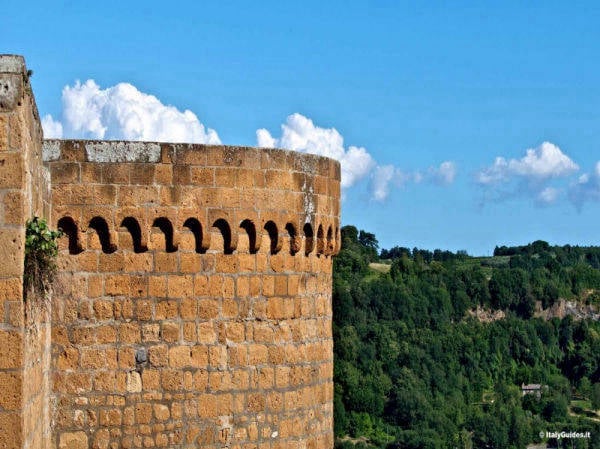
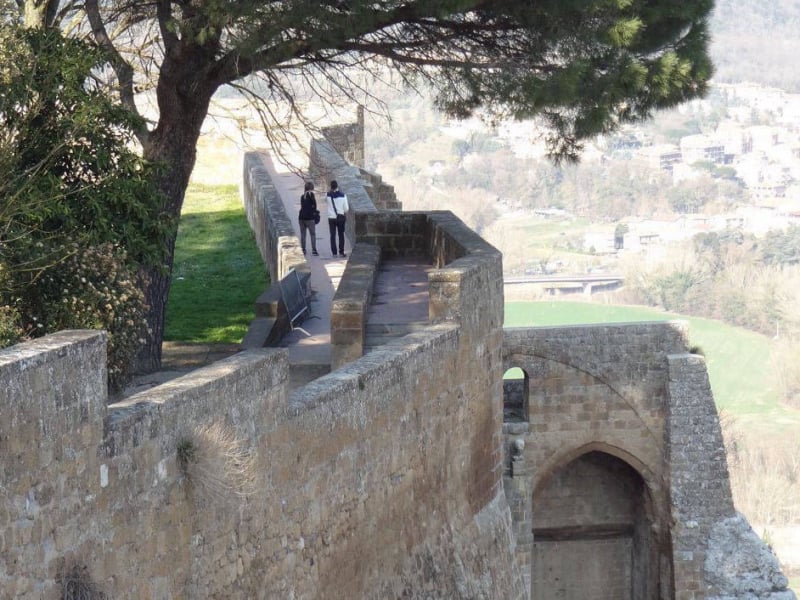
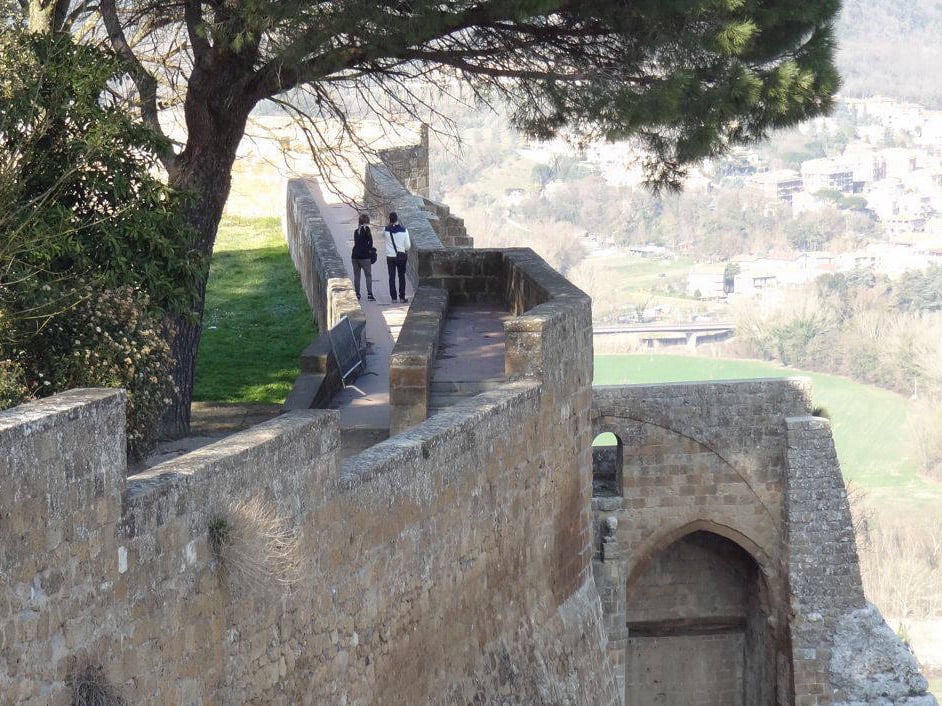
When you drive up to Orvieto and pass the Funicolare station you can easily miss the Albornoz fortress, but you should consider parking and go for a nice walk on the fortress grounds. Your will be rewarded with a spectacular view of the valley below. Leaning over the barricade walls gives you a good feeling of the once powerful fortress superb location.
Location:
Piazza Cahen (directions)
Orvieto
Opening hours
The fortress is open and no fees are charged for entering the fortress grounds.
Perched on the eastern edge of Orvieto’s volcanic plateau, the Albornoz Fortress (Italian: Fortezza Albornoz) is a commanding reminder of the city’s medieval strength and papal authority. Overlooking the Umbrian countryside and standing guard near the entrance to the historic city center, the fortress has played a strategic, political, and symbolic role in Orvieto’s long and layered history.
Origins and Context: The 14th Century
The fortress takes its name from Cardinal Gil Álvarez de Albornoz, a Spanish churchman and military leader sent by Pope Innocent VI in the mid-14th century to reestablish papal control over the Papal States. At that time, central Italy was fragmented by local warlords, rebellious communes, and rival noble families. Orvieto, like many towns, had enjoyed a period of semi-independence, dominated by feuding factions such as the Monaldeschi and Filippeschi.
To secure the Pope’s influence and restore order, Albornoz commissioned the construction of several fortresses across central Italy — from Spoleto and Ancona to Assisi and Orvieto. These were not only military bases but also symbols of papal power meant to assert dominance over the local populations.
Construction and Strategic Role
The fortress in Orvieto was begun in 1359 on the eastern edge of the city, incorporating part of the existing city walls. It was built near Porta Rocca, one of the main gates of the medieval city. The location was carefully chosen to control access to the town and to dominate both the internal factions and external threats.
Construction was entrusted to the papal architect Matteo di Giovannello, known as Gattapone, who also worked on similar papal fortifications elsewhere. The fortress featured thick walls, watchtowers, and an internal courtyard, reflecting the military architecture of the time. It was designed to house a papal garrison and act as a deterrent against rebellion.
In its prime, the fortress allowed the papacy to exert direct influence over Orvieto, a city that had previously hosted several popes during periods of unrest in Rome. The fortress also served as a secure refuge for clerics and dignitaries traveling along the Via Cassia and other important routes.
Decline and Transformation
As papal authority consolidated and the Italian political landscape shifted in the late Middle Ages and Renaissance, the fortress gradually lost its military importance. By the 16th and 17th centuries, changing warfare technology (such as gunpowder and artillery) made many medieval fortresses obsolete. The Albornoz Fortress was partially dismantled, repurposed, or left to deteriorate.
In the 19th century, with the unification of Italy and the end of the Papal States, Orvieto became part of the new Kingdom of Italy. The fortress, no longer serving a military function, was largely abandoned.
However, in the 20th century, interest in Orvieto’s medieval heritage prompted restoration efforts. Portions of the walls and towers were preserved or rebuilt, and the site was reimagined as a public park and lookout point. The garden inside the fortress, filled with cypress trees and local flora, became a peaceful space for both locals and visitors.
The Fortress Today
Today, the Albornoz Fortress is one of Orvieto’s most evocative landmarks. Although only parts of the original structure remain, it offers:
- Panoramic views over the surrounding Umbrian countryside and vineyards.
- A scenic public garden within its walls.
- Access to walking paths around the fortress and the Anello della Rupe, a trail circling the tuff cliff of Orvieto.
- A historical entrance to the city near the funicular station, making it a first stop for many arriving in Orvieto.
While the fortress no longer serves its defensive function, it continues to represent Orvieto’s enduring strategic importance and its complex relationship with the papacy.
Cultural and Symbolic Significance
The Albornoz Fortress is more than just a relic of medieval military engineering; it is a symbol of power, control, and transformation. It embodies:
- The centralization of Church power in the 14th century.
- The clash between local autonomy and external authority.
- The transition from medieval warfare to modern civic identity.
It also serves as a reminder of Orvieto’s role in the broader narrative of Italian and papal history — a town that, while relatively small, sat at the crossroads of politics, religion, and regional ambition.
Conclusion
The Albornoz Fortress stands as a quiet sentinel over Orvieto — its walls no longer echoing with the clamor of arms, but with the footsteps of travelers seeking to understand the city’s rich past. Whether as a strategic fortress, a political tool, or a modern public park, it continues to offer perspective — both literal and historical — on the hill town that surrounds it.
Location of Albornoz fortress.