St. Patricks well, located in the town of Orvieto in Umbria, is an extraordinary feat of Renaissance engineering.
Built in the 16th century at the request of Pope Clement VII, the well stands not only as a practical solution to a water supply problem, but also as a symbol of ingenuity, religious measning, and architectural brilliance. With its double-helix staircase and drizzling depth of over 50 meters, St. Patricks well is both a historical monument and a lasting testimony to human determination in the face of adversity.
Address
Piazza Cahen
Orvieto
Opening hours
The well is open every day from 9:00 to 18:45.
Ticket required.
Hint: Take your time and bring water. The walk up and down takes a little time, but it's worth the efforts.
The well was commissioned during a time of great turmoil and uncertainty. In 1527, Rome was sacked by the troops of Charles V, Holy Roman Emperor. The brutal invasion forced Pope Clement VII to flee the city and seek refuge in the hilltop town of Orvieto, which was then part of the Papal States. Orvieto was strategically located and defensible, but it lacked a reliable water supply that could support a prolonged siege.
Fearing that the town could become isolated and starved of water if attacked, Pope Clement VII ordered the construction of a deep well to ensure access to fresh water at all times. He entrusted this monumental task to Antonio da Sangallo the Younger, a prominent architect of the High Renaissance and a pupil of Bramante. Sangallo was renowned for his military architecture and practical designs, making him an ideal choice for such a challenge.
Engineering Marvel
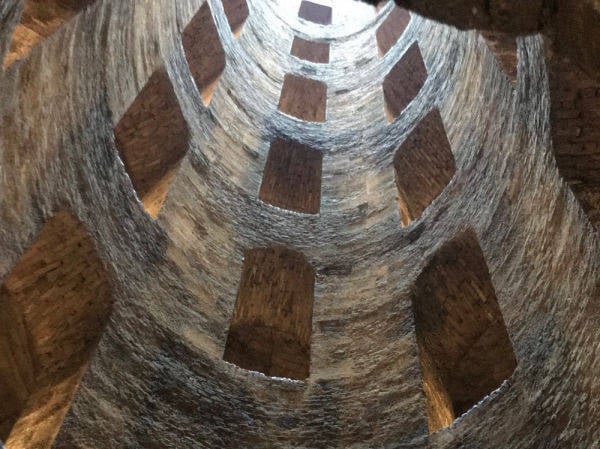
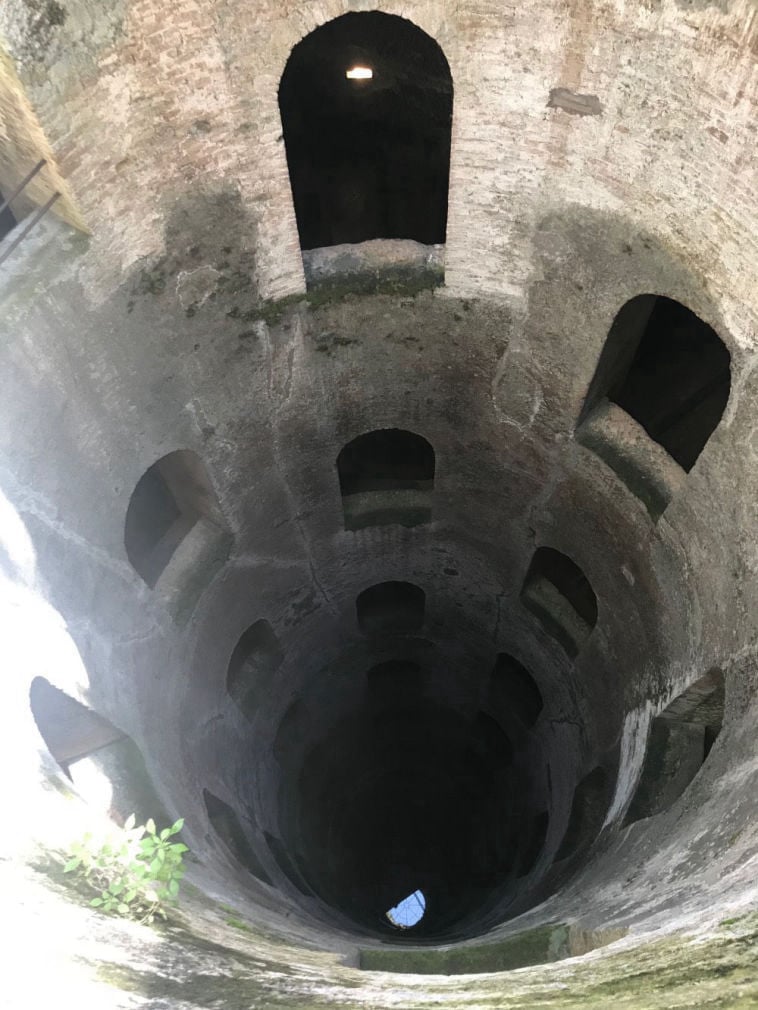
Construction of the well began around 1527 and was completed in 1537, during the papacy of Paul III. The final structure stands approximately 62 meters (203 feet) deep and 13 meters (43 feet) in diameter. Its most remarkable feature is the ingenious double-helix spiral staircase design: two separate helical ramps wind around the central shaft, allowing mules to descend one ramp, collect water at the bottom, and return up the other without crossing paths.
This design was highly advanced for its time. The staircases consist of 248 steps each and are illuminated by 72 windows carved into the stone walls, providing both natural light and ventilation. The well was lined with bricks and reinforced with stone, ensuring stability and durability over the centuries. The double-helix structure is often cited as one of the earliest examples of such a design, which would later become famous in other architectural and scientific contexts.
Religious and Symbolic Meaning
Although its construction was driven by military necessity, St. Patrick’s Well carries strong religious symbolism. The name “St. Patrick’s Well” was given in reference to the Irish saint who, according to legend, had a deep cave in County Donegal that allowed access to purgatory. Pilgrims who descended into the cave believed they were journeying through the suffering of the afterlife toward redemption.
The well in Orvieto, with its seemingly endless descent into the earth, was metaphorically associated with that same spiritual journey. The descent into darkness followed by a climb back into the light symbolized the path of penitence, suffering, and salvation. This religious dimension added to the well’s cultural importance and made it a site of contemplation, not just utility.
Cultural and Architectural Legacy
St. Patrick’s Well has stood the test of time not only because of its robust construction but also because of its unique aesthetic and technical design. It is considered one of the most significant examples of Renaissance civil engineering, blending utility with beauty and innovation.
The structure has inspired generations of architects, artists, and scholars. Its double-helix staircase in particular has been admired for centuries and has influenced both architectural and scientific designs, including representations of DNA’s structure in modern biology. The well also became a symbol of the Renaissance ideal—where art and science, faith and function, were seamlessly integrated.
Over the centuries, the well has remained in use and preserved as a historical monument. Today, it is a major tourist attraction in Orvieto, drawing thousands of visitors each year who descend its spiral ramps to marvel at the engineering and historical atmosphere.
Modern Significance
In contemporary Italian culture, the expression “fondo di San Patrizio” (“St. Patrick’s bottomless well”) has come to mean something that consumes resources endlessly—akin to a black hole. This idiomatic usage reflects the way the well has entered the cultural imagination far beyond its original practical purpose.
Tourists who visit Orvieto are often captivated by the experience of descending into the depths of the well, stepping into the footsteps of Renaissance laborers, clergy, and citizens. The emotional and physical journey down and up the spiral paths continues to evoke reflection on the challenges faced by past generations and the perseverance needed to overcome them.
St. Patrick’s Well also serves as a symbol of sustainable planning and resilience. Built in response to crisis, the well was an investment in long-term survival, a lesson that remains relevant today as societies face challenges related to climate, infrastructure, and urban planning.
Conclusion
St. Patrick’s Well is a masterpiece of Renaissance engineering, born from the need for security and transformed into a symbol of spiritual and cultural depth. Its elegant design, technical ingenuity, and layered meanings continue to fascinate and inspire. As both a historical artifact and a living monument, the well reminds us of the power of human creativity in times of crisis—and the enduring legacy that such creativity can leave for future generations.
The location to St. Patricks well (Posso di San Patrizio) in Orvieto.